My Experience with Zeabur: A Hands-on Review
Update 2026/08/30
Zeabur changed a lot after I wrote this article:
- Shared clusters are gone. The pricing model is different now: when you create a project, you must pick a provider and rent a machine, which starts at about USD $10 per month. Cheaper options such as Alibaba Cloud or Tencent exist, but for users in Taiwan the background of these providers makes them a hard sell.
- On 08/29 an environment variable leak happened. Environment variables that users set on Zeabur were at risk of access by attackers.
For these reasons I no longer recommend Zeabur. Consider Railway instead.
A Quick Backstory
It was quite serendipitous. A few days ago, the founder of Zeabur came to Fukuoka. Around that time, I was actively looking to chat and grab meals with people. After sharing some thoughts on Twitter (X), thanks to the algorithm, I happened to see his tweet mentioning he was in Fukuoka and followed him. He promptly replied in the comments, and we ended up meeting in person the very next day.

The founder is a recent Computer Science graduate from Taiwan. We met up for mizutaki, one of Fukuoka’s signature hot pot dishes. I had a great time talking with Yuanlin that day—we exchanged a lot of ideas and perspectives, making it a truly enjoyable conversation.
You could tell right away that he is very accustomed to networking and communicating. Even though it was our first time meeting, we shared plenty of deep, genuine thoughts. At the time, I was helping out a Japanese startup; after hearing about our current roadblocks, he immediately offered potential ways to collaborate along with discounted options.
That mindset of first asking “How can I help?” is something I deeply admire, and it’s an attitude I strive for myself—even if it means taking a slight loss in the short term.
Zeabur — Deploy Your Services in One Click
Back to the main topic.
As a developer who loves deploying side projects, choosing the right platform is always a major decision. One big reason is that developers typically want an out-of-the-box deployment workflow. We want to get things live as quickly as possible rather than provisioning a virtual machine and configuring everything from scratch.
Over the years, I’ve used numerous deployment tools and cloud providers, including:
- AWS: including EC2, Serverless Functions, etc.
- GCP: App Engine, Cloud Run, Storage, Cloud SQL
- Vercel
- Netlify
- Cloudflare
- DigitalOcean
- Railway
So I have a pretty clear picture of what developers actually look for in a hosting service.
Today, I mainly want to introduce Zeabur. I’ll save my thoughts on other platforms for future posts!
From my own experience, traditional cloud hosting providers have several major drawbacks:
1. Relatively High Costs
Spinning up a managed database on GCP alone costs me over 2,000 TWD (~$65 USD) per month. The upside of managed services is high availability, automated backups, monitoring, logging, alerting, and so on, which saves a lot of operational hassle.
However, for small projects, these features often have cheaper workarounds or aren’t strictly necessary at all. For early-stage startups or indie developers with limited runway, keeping costs low is what truly matters.
In my view, unless your service has unique demands (high traffic, massive concurrency, etc.), servers are rarely as fragile as you might think.
2. Service Coupling Isn’t Clear
For example, a project might need to connect to a database, Redis, Kafka, and RabbitMQ. In AWS or GCP, you have to navigate across multiple separate console pages instead of viewing them directly within a single project dashboard. On the other hand, platforms like DigitalOcean merely hand you a virtual machine, leaving everything else for you to configure with no unified dashboard in sight.
3. Overly Complex Interfaces
AWS and GCP offer an overwhelming number of services. Most indie developers just need a server and a database, maybe a message queue at most. Yet their GUIs are cluttered with noise; just provisioning a machine or checking logs requires clicking through layers of menus, and it’s easy to get lost.
Some might argue that you can unify everything via APIs or Terraform. Yes, you can—you could build your own admin dashboard or manage everything with IaC, but that defeats the purpose of convenience. It’s simply not an out-of-the-box solution.
Railway
Two years ago, a coworker recommended Railway to me, and I fell in love with it immediately. Railway focuses on low costs and fast deployments; in practice, you really don’t need any complex configuration to get a service up and running.
There are several features I particularly love: defining custom dev / staging / production environments within a project, deploying from templates or Dockerfiles, and connecting with GitHub for automatic deployments on every new commit. For me, this is the most critical part—it eliminates the overhead of writing deployment scripts and lets me focus on writing code.
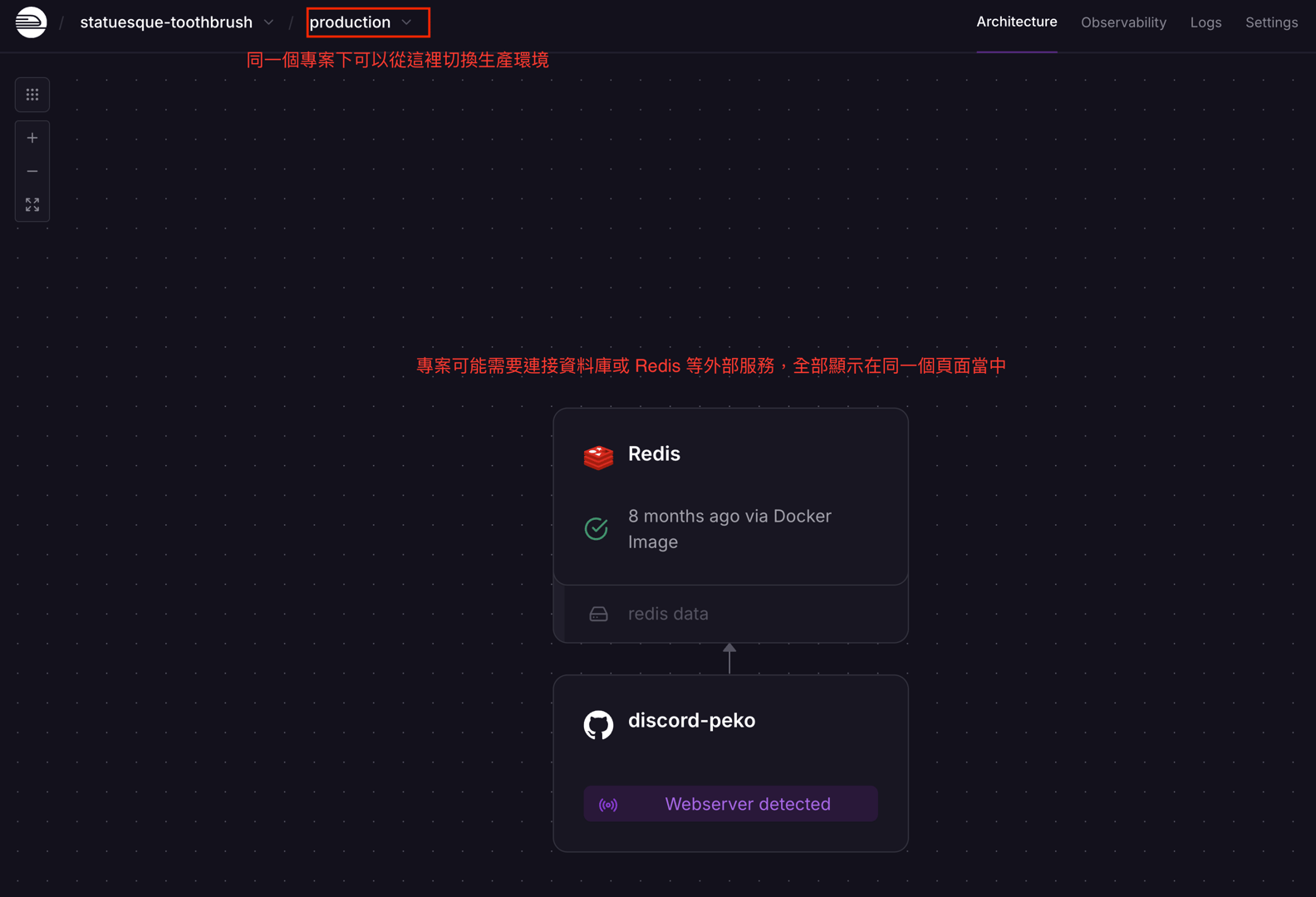
Within the same project, I can deploy a database, GitHub repositories, and Redis, with all internal and external service relationships clearly visualized.
Their pricing is also very developer-friendly. You can upgrade to the Hobby plan for $5, but if your usage stays below $5, you won’t be charged—essentially making it free within that threshold.
My blog’s database is currently hosted on Railway, costing only around $3 per month. The core codebase is hosted on Vercel, since Vercel still offers the best Next.js integration, and its Serverless Functions are free to use. For a blog, this setup is extremely convenient, and my traffic falls well within the free tier.
Introducing Zeabur
For developers who have already experienced the convenience of Railway, one-click deployments are nothing new. Zeabur also supports deploying from custom templates, Docker, and GitHub integration with auto-deploy on push. However, I think Zeabur stands out in a few key areas.
In terms of pricing, while Railway can be used for free as long as you don’t exceed the free tier, the limitation is that you cannot choose your deployment region. When it comes to network latency, server proximity still makes a real difference.
Zeabur, on the other hand, costs 5 usage credit. So as long as your usage doesn’t exceed 5/month.
Here is a side-by-side comparison with Railway:
| Railway | Zeabur | |
|---|---|---|
| Memory | $0.000231 / GB / minute ($10 / GB / month) | 4 / GB / month) |
| vCPU | $0.000463 / vCPU / minute ($20 / month) | $0.0003 / vCPU / minute ($12 / month) |
| Network Egress | $0.1 / GB | $0.1 / GB (First 100 GB free) |
| Volume | $0.2 / GB | $0.25 / GB |
As you can see, Zeabur has an edge over Railway in pricing. While the unit price for network egress is the same, Zeabur includes 100 GB of free egress. If your usage exceeds $5, Zeabur is definitely the more cost-effective choice.
Currently, my deployed services are just my blog and some bots, so I rarely have to worry about egress spikes. However, for services requiring real-time communication or those with heavy server-side processing, egress is a critical and often unpredictable cost factor.
Having 100 GB of free egress per month is a huge plus in my book! Furthermore, Zeabur offers project-level budget controls: you can cap your monthly spending at a specific limit, and services will automatically pause once reached to prevent unexpected charges.
1. User Experience
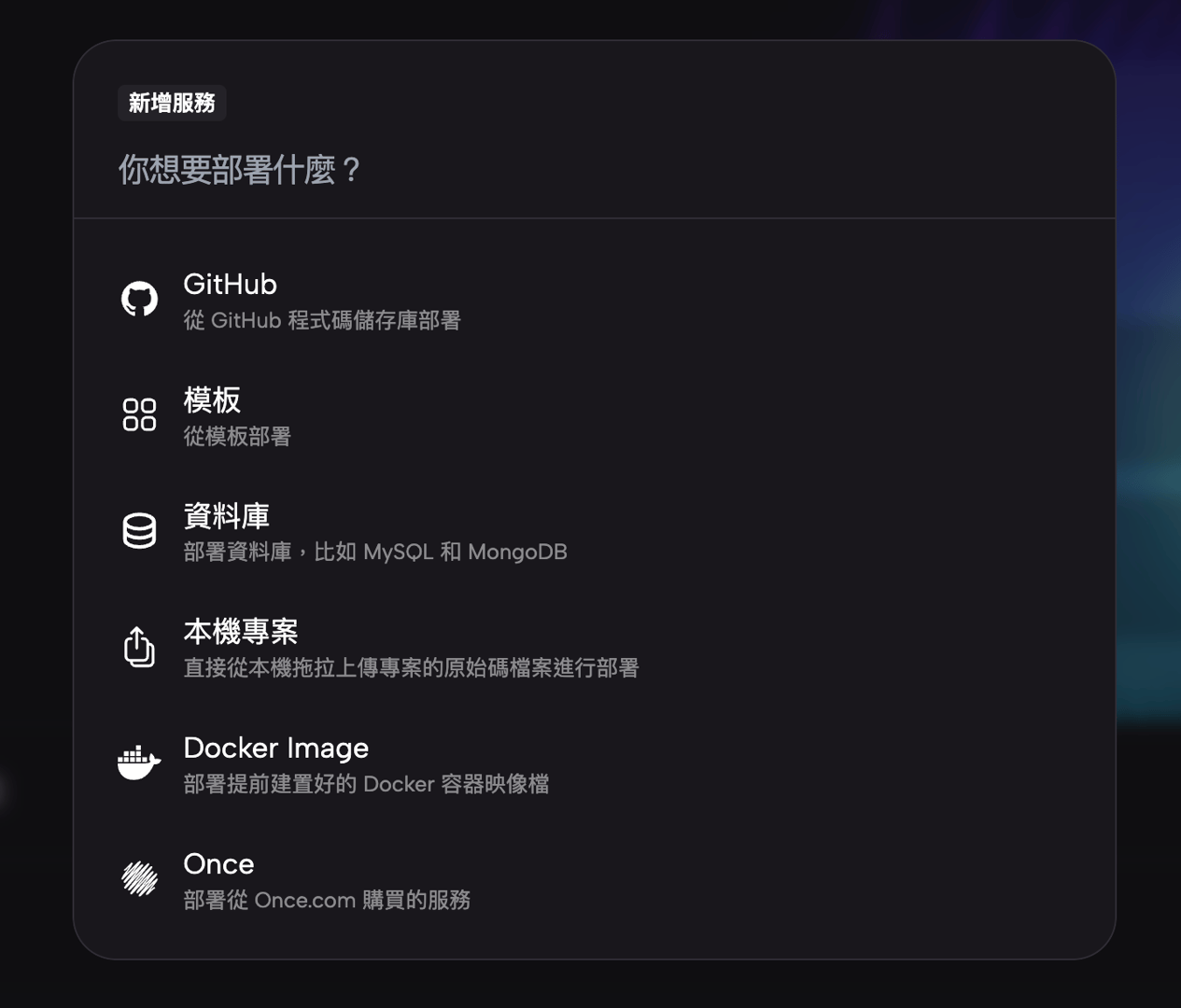
Setting up services on Zeabur is a breeze. Through the GUI, you can provision databases, use pre-built Docker images, connect to GitHub, or even deploy by dragging and dropping local files directly into the browser.
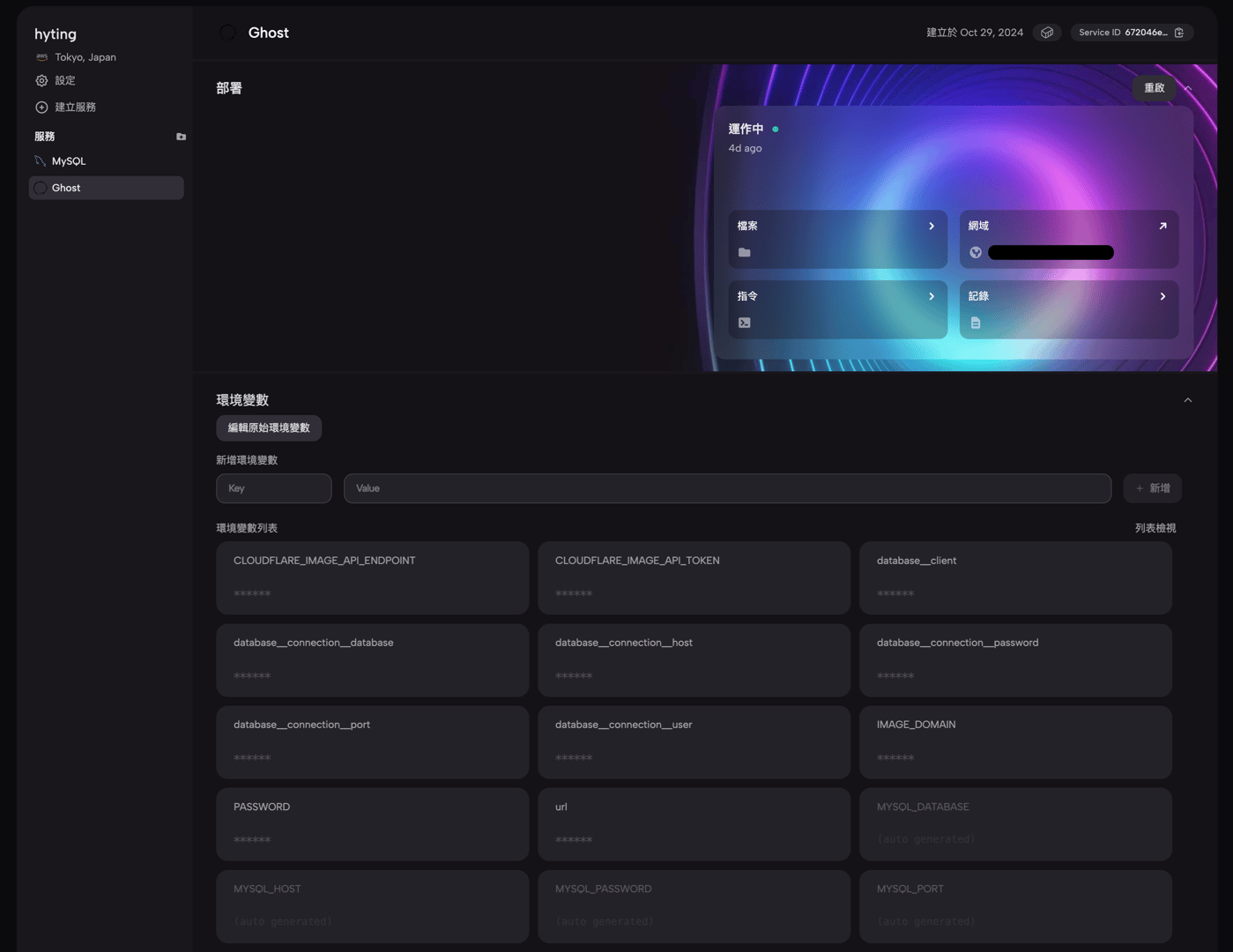
Once a Docker image is configured, you can add environment variables directly from the interface.
2. Community & Pre-built Templates
Zeabur provides a wide range of pre-built templates. For instance, when setting up WordPress, you probably want the database configured alongside it automatically. This is where Zeabur’s template feature shines. There is a rich library of templates available, and you can also write your own.
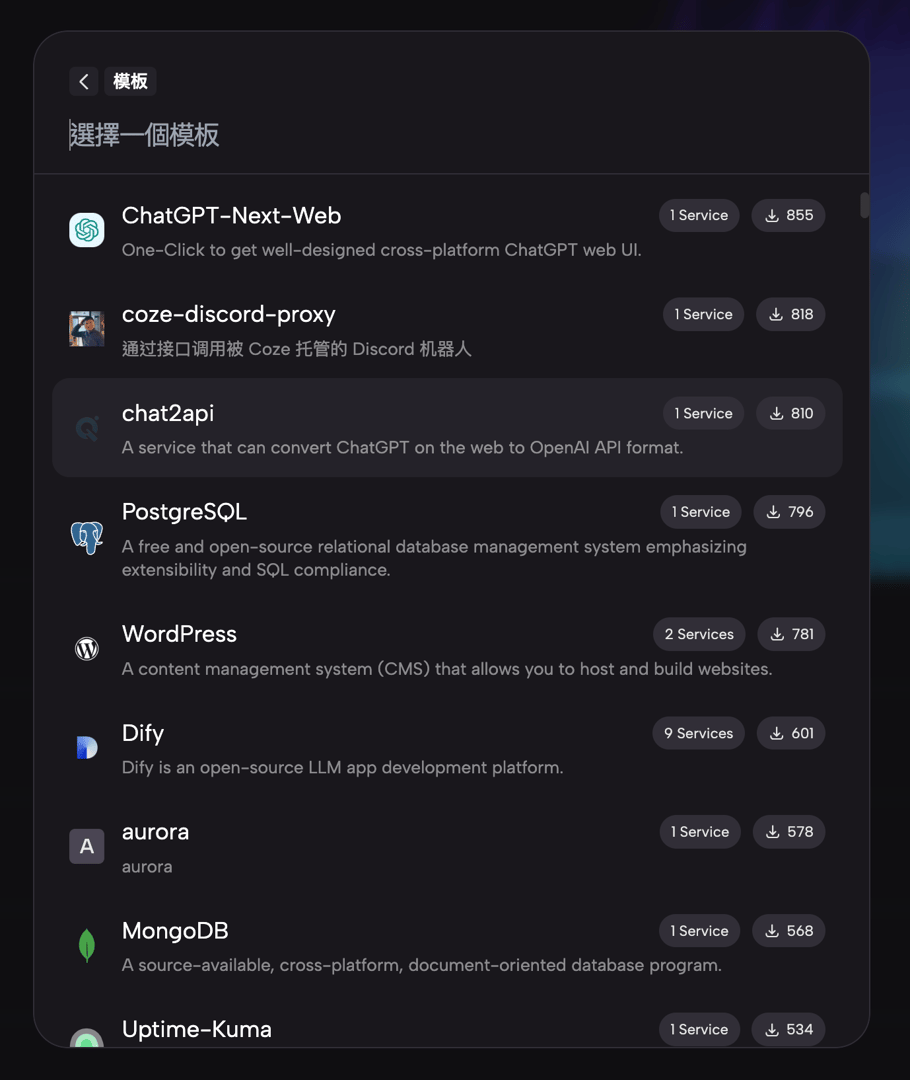
Under the hood, templates are just plain YAML files without any proprietary formats required.
3. Native Language Support
The developers are from Taiwan, so the official website and dashboard have authentic Traditional Chinese support. If you join their Discord, you can also open support tickets directly in Chinese.
For developers already comfortable in the English-speaking tech ecosystem, this might not seem like a big deal, but being able to communicate with support in your native language definitely feels different!
On Discord, you can see Zeabur’s developers actively communicating with users and resolving issues quickly. Since Zeabur is still a relatively young service, while everything works smoothly most of the time, you can get direct help from the team when issues arise without going through customer support gatekeepers—a huge advantage for many.
3. Multiple Cloud Provider Choices
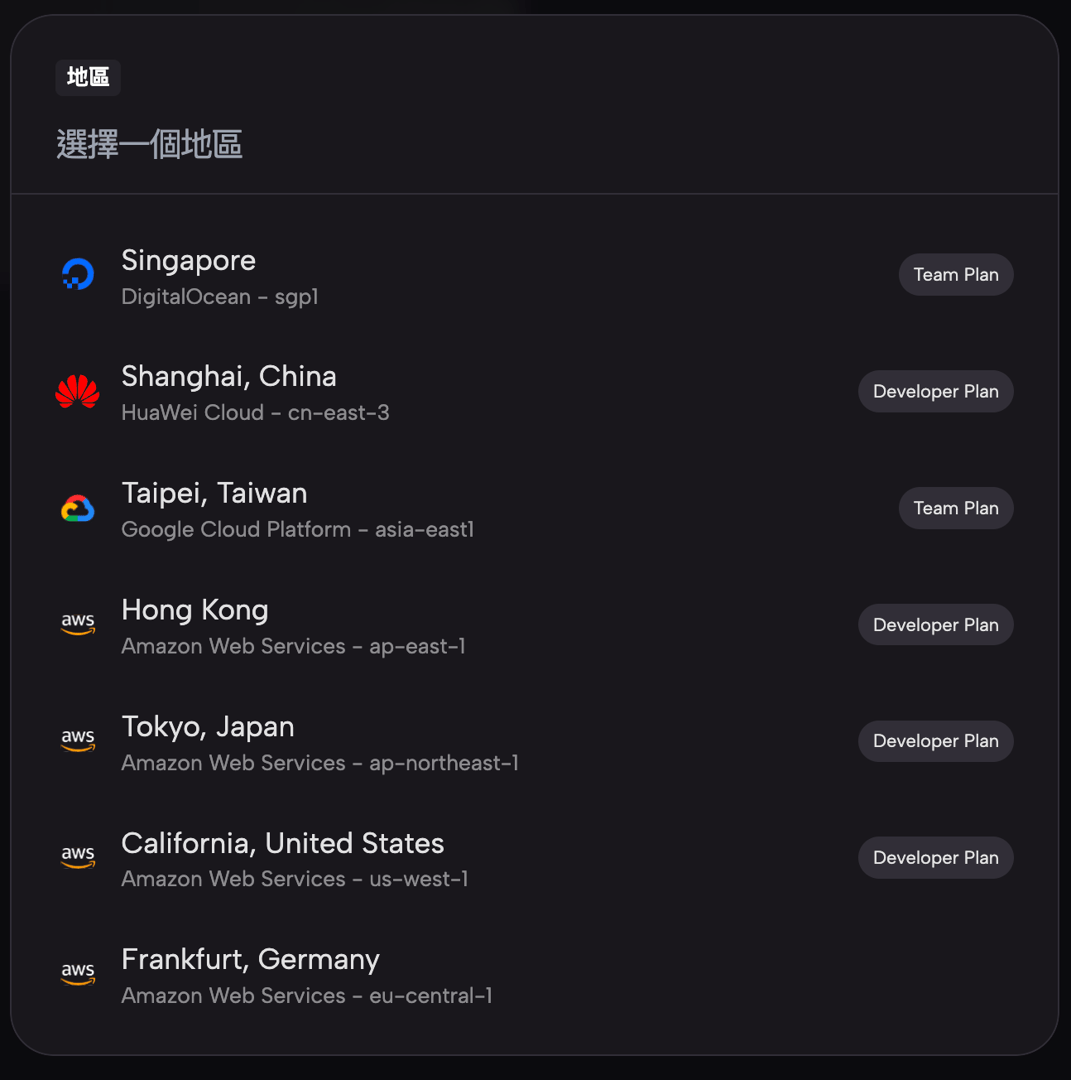
Under the Developer Plan, Zeabur lets you choose between AWS and Huawei Cloud regions. For AWS, you can pick from Hong Kong, Tokyo, Canada, and Germany. The Team Plan also offers GCP in Taiwan, which is super convenient for developers targeting users in Japan, Taiwan, or China.
4. Connect Your Own Servers (BYOS)
According to Zeabur’s documentation, the underlying architecture uses k3s along with monitoring tools. In theory, as long as you have a server, you can simplify your self-hosted deployments through Zeabur.
So beyond provisioning machines through Zeabur, you can also rent your own VPS and configure SSH access to let Zeabur deploy and manage your services—essentially offloading all deployment operations to Zeabur.
Final Thoughts
While Zeabur shares some common ground with existing PaaS solutions on the market, my overall experience has been very satisfying. There are a few minor UI quirks and incomplete translations, but those are just minor nitpicks that will surely improve over time.
Beyond that, Zeabur’s pricing strategy is significantly cheaper than Railway’s, making it an ideal platform for indie hackers building an MVP.
Features like connecting your own servers and choosing deployment regions show that Zeabur is carving out its own distinct path. I’m very excited about its future development and plan to migrate some of my upcoming projects to Zeabur to show support.
If you want to run a blog or deploy services with databases and Redis without paying hefty managed hosting fees, definitely consider giving Zeabur a shot! (Though for static sites or pure Next.js apps, I personally still lean toward Vercel.)
For more advanced developers, you can also pair Zeabur with Cloudflare, letting Cloudflare handle proxying and caching—it should make for a great setup. (It’d be even better if Zeabur offered direct Cloudflare integration! 😂)
Related Posts
- When a Measure Becomes a Target: From the Window Tax to Pull Request Counts I once wrote a script to tally how many PRs I contributed in a quarter, how many reviews I left, and how many tickets I closed, hoping to use numbers to prove my output to my manager. My manager simply remarked that performance isn't just about output. Years later, I finally understood—when a measure becomes a target, it ceases to be a good measure. From the British window tax and the Hanoi rat bounty to evaluating developers by PR counts today, the underlying mechanism is exactly the same.
- Using Cloudflare Images for Image Storage and Transformation Putting an image on a webpage is the simplest task in frontend development. But doing it properly—including resizing, generating multiple formats, and withstanding heavy traffic—is actually an entire end-to-end solution. Eventually, I offloaded everything to Cloudflare Images, keeping only a single original image.
- Stop Using AWS Access Keys Access Keys are an easily overlooked security risk in AWS. By pairing OIDC with IAM Roles, GitHub Actions can securely operate AWS resources without storing any secrets.
- Database Primary Keys: AUTO_INCREMENT, UUID, and UUIDv7 Backend developers often face the choice of primary keys: should you use auto-increment or UUID? What about collisions? How does UUIDv7 compare to created_at + index in performance? Here are the design decisions and benchmark results from testing 20 million rows.