Are You Just a Critic?
Introduction
“Why didn’t you use Y?”
“Isn’t this super basic?”
“I told you from the start this wouldn’t work.”
Criticizing is easy. It makes you look smart, and who doesn’t enjoy that feeling of standing out from the crowd?
Persuading upper management is exhausting, pushing projects forward is exhausting, and cross-departmental communication is exhausting—yet all of them are hundreds of times better than merely criticizing.
Someone excitedly shares a new framework, and the comments read, “Reinventing the wheel again for no reason.” Someone writes a tech article, only to be hit with, “You can make an article out of this?” Someone quits their job to start a business, and friends say, “It’s bound to fail anyway.”
I admit, I used to be that person too.
As you gain more experience, you realize just how complex the world is. The curse of knowledge makes you instinctively think that nothing is as simple as it looks on the surface. At that point, the most comfortable stance is to take a step back and view everything through the lens of a “bystander.”
Saying these things feels great. Zero cost, zero risk, plus a nice little dose of intellectual superiority. But aside from making you feel good about yourself, it helps nothing.
In a large project involving financial processes, I once sneered at the cumbersome, tedious procedures. Criticizing is easy, and pointing out problems is easy, but talking without doing won’t move the project forward, nor will the processes change overnight.
After a wake-up call from my manager, it hit me: clinging to idealism without being willing to get your hands dirty makes you the kind of person an organization fears most.
From the perspective of driving projects forward, I also really like the decision-making principle popularized by Amazon founder Jeff Bezos: “Disagree and Commit” (which he mentioned on Lex Fridman’s podcast)—disagree, but still go all-in.
Recent projects have reinforced this for me. When I disagree on something, if it won’t severely impact the project, moving the project forward takes top priority. On the flip side, if we hit a blocker, I’ll do whatever it takes to escalate it to leadership, using data to persuade stakeholders why it matters and what consequences will follow if left unaddressed.
Making Things Better
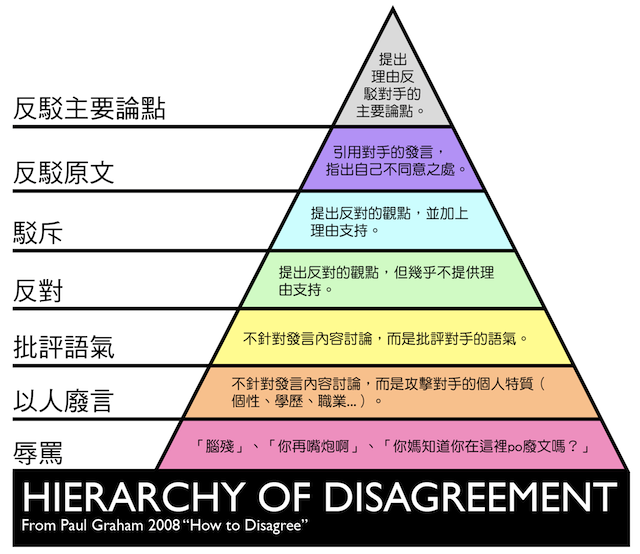
(Image source: 哲學哲學雞蛋糕)
This comes from a translation of Paul Graham’s essay, How to Disagree, by 哲學哲學雞蛋糕. It describes the hierarchy of disagreement. Most comments on the internet get stuck between levels one and four.
While that piece is about how to argue, I think some of its core concepts apply here as well.
I believe good criticism should have:
- Understanding the other person: Good criticism starts by understanding their context and thought process.
- Offering solutions: Good criticism points out shortcomings while proposing actionable alternatives.
Conversely, criticism that questions motives helps no one.
Addicted to Criticism
Being an armchair critic feels great.
- Zero cost: Leaving comments online carries zero accountability; the more sensational the words, the more attention they attract.
- Superiority: Posting snarky remarks when someone pours their heart into something and fails, then retweeting with “See? Told you so.” It proves you saw further than they did, cheapening their effort with a single sentence.
- Instant gratification: Someone might spend days researching and outlining a thoughtful tech article, but you can dismiss it all in a single sentence. The ROI on ego is ridiculously high.
Once this mindset sets in, you even start deceiving yourself. You start thinking everything others do is foolish and all their efforts are laughable. Over time, you’re trapped in your comfort zone, doing nothing but nitpicking others.
I’ve learned this the hard way. In past code reviews, I often forced my subjective preferences onto other people’s implementations just to show off what I knew.
Yet, I rarely stopped to consider how to actually make the project better, or how to communicate what I considered good practices to the team effectively.
The Burden of Expertise
Nothing is simple. Every issue has two sides, every action has side effects, and every ideal holds contradictions.
Yet it’s precisely this mindset that stops you from taking the first step.
Knowing how many details a product launch requires, you choose not to build anything at all—and then scoff at those who proudly share what they’ve built on social media.
This mindset will crush you. Given enough time, criticizing others will be the only thing left you know how to do.
When Engineers Become Critics
This is a trend I’ve noticed in the tech community.
At some point, certain senior engineers stop writing code altogether. Their primary output shifts to reviewing others’ code, critiquing others’ articles, and opining on tech decisions across social media.
When they see someone coding with AI, they claim it’s all garbage.
“This architecture is too naive.”
“That article is too shallow.”
“This tech stack choice is flawed.”
They might not even be wrong. But they haven’t produced anything of their own in a long time.
Critiquing is easy. You don’t bear the burden of maintenance, face the risk of failure, or spend hours polishing prose and debugging code. In just a few minutes, a sharp critique grants you the halo of a technical authority.
Am I still a creator? Or have I unwittingly turned into a critic?
Distinguishing Constructive Criticism
Some people take every piece of feedback as criticism, using it as an excuse to dodge conversation. When you point out a problem, they treat it as “nitpicking.” When you raise concerns about a decision, they claim you’re singling them out.
Questioning something and asking for clarification is completely normal in the workplace; it’s a sign that the other person actually values your output.
So how do you tell the difference? Look at what they’re questioning. See if they offer concrete solutions or suggest a viable direction.
When I give feedback to others, I try to include my reasoning whenever possible. Here are a few examples:
- When a report lacks key metrics, I’ll follow up: “I think this number is crucial because it directly affects the client’s budget, so we should include it.” (An even better approach is to have already calculated it yourself.)
- “This implementation routes all the traffic directly to the backend server. Should we consider offloading the image uploads to a CDN instead?”
Sure, you could say, “Wait, you didn’t even think of this? Are you slacking off?”, but how much does saying that actually help achieve the goal?
There is one caveat: social media.
Social media is flooded with low-quality arguments—unsubstantiated claims, emotional mudslinging, and endless loops where nobody convinces anybody. Keeping your distance from this noise is the right call. Not every conversation is worth joining; online comments are toxic.
If You Give Up Now, the Game Is Over
Even more dangerous than criticizing others is criticizing yourself.
“There’s no way I can pull this off.”
“No one will read this even if I write it.”
“Isn’t it too late to start at my age?”
These self-criticisms feel very real, but they also become convenient excuses to justify inaction—“why bother if it’s pointless anyway?”
Conclusion
Being a critic feels great, but it’s also hollow. It leaves nothing behind.
What I find far cooler is seeing through the world’s absurdity and contradictions, carrying anxiety every single day, yet still clinging to your ideals and naivety, taking action step by step.
Related Posts
- How to Prepare for Software Engineering Interviews Preparing for tech interviews has always been challenging. One of the most frustrating parts is the heavily one-sided power dynamic. As a candidate, it's hard to gauge their actual standards, and it's easy to spiral into self-doubt afterward. Let's talk about it.
- Words That Changed My Outlook on Life Feynman, Chaplin, and the movie Hyakumeter: from an insecure boy to someone capable of helping others, sharing the reflections and life philosophies that shaped me most.
- N Benefits of an Independent Website Why spend time running your own blog in an era dominated by short-form video and social media? Here are my thoughts after nearly a decade of blogging.
- Reflections on Fitness and Weight Training Sharing my thoughts and journey with weight training over the past period.