Why I Switched from Google Analytics to Plausible
# Random TalkThis is my submission for the January 2026 BlogBlog Club event. It had been sitting in my drafts for a long time, so I figured I’d publish it on this occasion. Thanks to wiwi for hosting BlogBlog.Club!
I really dislike using Google Analytics. Besides being not very pleasant to use, it has so many features that it’s overwhelming, and the dashboard interface and loading speed are so complicated that I don’t even want to open it.
Most people just want to know basic things like how many visitors came today, which pages they’re looking at, and how traffic has changed recently. But when you open the GA4 dashboard, you first have to spend ten minutes figuring out where everything is, and you even have to take a certification exam to prove you’ve mastered GA4 and know how to set up all those dizzying dashboards.
So I started looking for various analytics tools. At first, I thought open-source tools would be too much trouble, so I figured I’d just use Cloudflare’s built-in analytics. But Cloudflare analyzes data directly from HTTP requests, so crawler requests are counted too, which means the data isn’t always accurate.
Later, I found Plausible (I think it was recommended by someone on Twitter/X—thank you!), and after using it, I never looked back. Here are a few reasons I like Plausible:
Simple interface
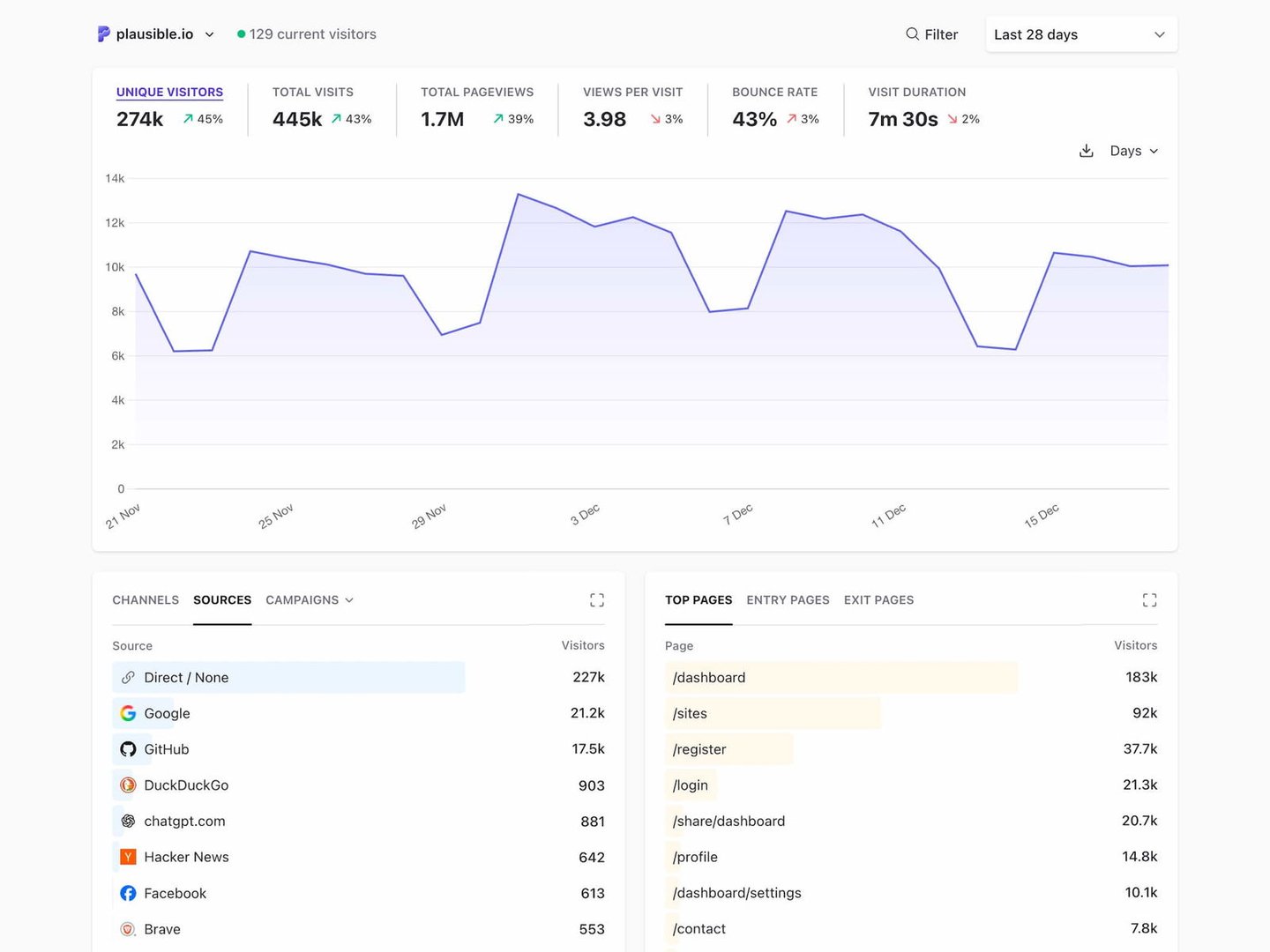
When you open the dashboard, it’s just a one-page view: traffic, sources, and top pages are all clear at a glance. No need to spend time learning the interface, and no need to take classes or get certified. Everything you need is there, and the features you don’t need won’t pop up to bother you.
Lightweight
Plausible’s script is less than 1KB, which makes a noticeable difference for people who care about their site’s JavaScript footprint (though with Next.js, I’m not exactly in a position to talk 😂). By comparison, Google Analytics requires tens of KB.
What matters most to me is that once I’ve set it up, I can forget it exists. Every so often I open it to check traffic, and knowing that people are visiting is enough. A website analytics tool really shouldn’t take up too much mental energy.
Privacy
If the websites a user visits also have third-party cookies from services like blogs or other services that use Google sign-in, then when you browse those pages, the cookies will be sent along with requests if the conditions are met. Once the server receives them, it can identify who you are, thereby achieving user behavior tracking.
Come to think of it, Safari was really ahead of its time—it defaulted to blocking third-party cookies very early on.
No cookie-based tracking
GA originally used cookies for tracking. In 2019, Google announced it would phase out third-party cookies, and GA was revamped into GA4, which completely abandoned third-party cookies. But in practice, because of the advertising business, it’s hard to force third-party cookies to be completely blocked. The current approach allows users to decide whether to enable third-party cookies by adjusting settings.
You can refer to the Chrome cookie policy changes and reflections I wrote a few years ago.
Plausible doesn’t use cookies. It generates a daily-changing identifier using the IP address and User Agent, processed through a salted hash: hash(daily_salt + website_domain + ip_address + user_agent)
This hash is only used to count visits for that day. The original IP and User Agent are not stored, and old salts are deleted every 24 hours. Even if someone wanted to brute-force the IP back out, they couldn’t.
Can be self-hosted
You can use Plausible’s official paid plan, which is billed based on pageviews: 29 for 100K page views.
That’s not expensive, but if you want to save money, Plausible is also open source. If you have an idle server, you can self-host it yourself, or just use a cloud service. Zeabur even provides a template for one-click deployment.
Self-hosting has another benefit: you can set up a subdomain. Although Plausible itself doesn’t need cookies, some ad blockers detect whether requests are coming from a non-subdomain, and if it’s under the same domain it won’t be flagged as ads or tracking.
Plausible is one hundred times easier to use than GA! And it’s a lighter service that cares more about user privacy. If your website also needs analytics, give Plausible a try.
If you plan to deploy with Zeabur, you can consider using my referral code! I’ll receive a $5 reward.
Related Posts
- Are You a Critic?Being a cynical critic feels great and makes you feel superior, but in the end you’ll realize it leaves you with nothing but emptiness.
- Why Company Stage MattersMany people use terms like startup, growth stage, and stable stage to describe companies, but these words are too vague to serve as useful criteria. What is this company surviving on right now? How does it grow? What is its most painful problem? If you understand company stage, you’ll know what problems you’re solving every day, and whether this company is actually a good fit for you.
- Sunwide ViewSunwide View and Vigilante Justice
- ShuraSpring and Shura