Are You a Critic?
# Random TalkPreface
“Why not use Y?”
“That’s so basic.”
“I told you from the beginning this wouldn’t work.”
Criticizing is easy. It also makes you look smart, so why not enjoy that feeling of standing out from the crowd?
Persuading management is tiring, pushing projects forward is tiring, and communicating with other departments is tiring too — but all of that is far more meaningful than criticism.
Someone enthusiastically shares a new framework, and the comments say, “Oh great, reinventing the wheel again.” Someone writes a technical article and gets judged with, “This is enough to be called an article?” Someone quits their job to start a business, and a friend says, “It’s going to fail anyway.”
I admit it: I used to be that kind of person too.
As experience accumulates, you come to understand how complex the world is. The curse of knowledge makes you instinctively think that nothing is as simple as it first appears. At that point, the most comfortable stance is to take a step back and look at everything from the perspective of an “observer.”
These kinds of comments feel great to say. Zero cost, zero risk, and they give you a little intellectual superiority. But aside from making yourself feel good, they don’t help at all.
In a large project I once worked on, because it involved finance-related processes, I also sneered at those tedious, lengthy procedures. Criticizing is easy, and pointing out problems is easy too, but talking without taking action won’t move the project forward, and the process won’t magically change tomorrow.
After a manager pointed this out to me, I suddenly realized: if you only cling to idealism and refuse to get your hands dirty, you become the kind of person organizations fear most.
From the perspective of pushing a project forward, I also really like Amazon founder Bezos’s decision-making method — Disagree but Commit (mentioned on Lex Fridman’s podcast): disagree, but still give it your full effort.
Recent projects have given me a deep appreciation for this. When I come across something I disagree with, if it won’t have a major impact on the project, moving the project forward should be the top priority. On the other hand, if I hit a real blocker, I’ll do everything I can to report it upward, using data to persuade stakeholders why it matters and what consequences there will be if it isn’t addressed.
Making Things Better
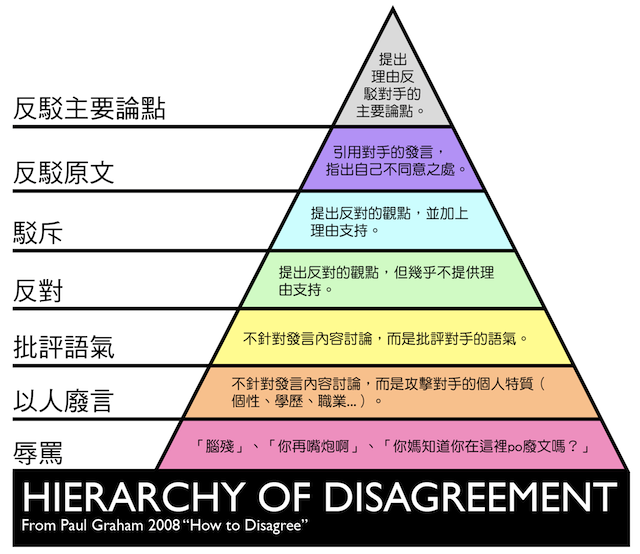
(Image sourced from Philosophy Cake)
This is Philosophy Cake’s translation of Paul Graham’s How to disagree. It discusses different levels of disagreement. Most online comments only stay at levels one to four.
Although that article is about how to argue with people, I think some of its core ideas can be repurposed.
I believe good criticism should have:
- Understanding the other person: good criticism should begin by clarifying the other person’s context and thought process
- Offering solutions: good criticism should not only point out what is wrong, but also provide alternative approaches
Conversely, criticism that is completely unhelpful is merely questioning motives.
Addiction to Criticism
It feels great to talk trash.
- Zero cost: posting a comment online doesn’t require you to take responsibility, and the more sensational the text, the more attention it gets
- A sense of superiority: posting to mock someone who was full of passion and then failed, and then retweeting with a line like — “See? I told you so.” Proving you saw further than others with one sentence, making all of someone else’s effort look like a joke
- Instant feedback: someone else’s carefully written technical article may have taken days of thinking and verification, but with just one sentence you can overturn it. The return on investment is absurdly high
Once you develop this mindset, you’ll find that even you begin to deceive yourself. You start to think that everything other people do is stupid, that other people’s efforts are ridiculous. Over time, you can only stay in your safe zone and nitpick others.
I’ve suffered a lot because of this. In the past, during code reviews, I often imposed my own subjective opinions on other people’s implementations, simply because I wanted to show off my knowledge.
But I rarely thought about how to make the project better, or how to communicate the approaches I thought were good to the team.
The Baggage of Being an Expert
Nothing is simple. Every issue has pros and cons, every action has side effects, and every ideal contains contradictions.
But it is precisely this mindset that makes me afraid to take the first step.
Knowing that there are many things to consider before a product goes live, I choose not to do it. And then I laugh at the people who put finished products on social media.
This mindset will crush you. Over time, all you can do is criticize others.
When Engineers Become Critics
This is a phenomenon I’ve observed in the tech world.
Some senior engineers, at some point, stop writing code. Their main output becomes commenting on other people’s code, criticizing other people’s articles, and weighing in on various technical decisions on social media.
When they see people starting to write things with AI, they say the other person is just writing garbage.
“This architecture is too naive.”
“That article is too shallow.”
“This technical choice is problematic.”
They may all be right. But they themselves haven’t produced much in a long time.
Criticism is easy. You don’t have to take responsibility for maintenance, you don’t have to face the risk of failure, and you don’t have to spend time polishing writing or debugging. Spend a few minutes writing a sharp comment, and you can gain the aura of technical authority.
Am I still a creator? Or have I, without realizing it, already become a critic?
Distinguishing Constructive Criticism
Some people treat every opinion as criticism, using that as a way to avoid dialogue. When you point out a problem, they interpret the criticism as “nitpicking.” When you raise concerns about a decision, they say you’re targeting them.
In the workplace, asking questions and requesting clarification is completely normal. It’s the result of the other person valuing your output highly.
So how do you tell the difference? Look at what the other person is questioning, and see whether they offer a concrete solution or a suggested direction.
When I give suggestions to others, I try to include my reasoning as much as possible. Here are a few examples:
- If a report is missing key data, I might ask: “I think this number is important because it affects the client’s budget, so it should be included.” (The higher-level version is when I’ve already calculated it myself.)
- This implementation would route all traffic to the backend server. Should we consider uploading the images to a CDN instead?
Of course, you could say, “Huh? You didn’t even think of that? Are you just here to coast?” But how much would that sentence help us achieve the goal?
There is one thing to watch out for: social media.
Social platforms are full of low-quality arguments — unsupported claims, emotional name-calling, endless loops where no one convinces anyone. Keeping your distance from that is the right choice. Not every conversation is worth joining. Internet comments are toxic
If You Give Up Now, the Match Is Over
More frightening than criticizing others is criticizing yourself.
“I can’t do something like this.”
“Even if I write it, no one will read it.”
“Isn’t it too late to start at this age?”
These criticisms of yourself are realistic, but they can also become excuses for rationalizing inaction — anyway, it wouldn’t make a difference even if you tried.
Conclusion
Being a critic is satisfying, but also empty. It leaves nothing behind.
What I think is cooler is someone who sees through the absurdity and contradictions of this world, feels uneasy every day, yet still holds on to their ideals and innocence, taking action step by step.
Related Posts
- The N Benefits of Having Your Own WebsiteWhy bother maintaining your own blog in this era of short-form video and social media? Here are my thoughts after writing a blog for nearly ten years.
- Fitness (Weight Training) ReflectionsSharing my recent weight-training reflections
- Rights and Responsibilities: The Root of Workplace InvolutionHow do you make employees work overtime every day? How do you make them work as hard as a boss? Give them the same equity.
- Defaults and TasteAn essay extending Wiwi’s “Default” — discussing the unwritten rules of Fukuoka escalators, how AI content takes over SEO rankings, and Voltaire’s definition of taste.